
Europe has led the way on AI governance with the EU AI Act, but the latest shift in both the United States and the United Kingdom signals something important: the world’s largest economies are beginning to recognize that advanced AI cannot remain entirely self-regulated.
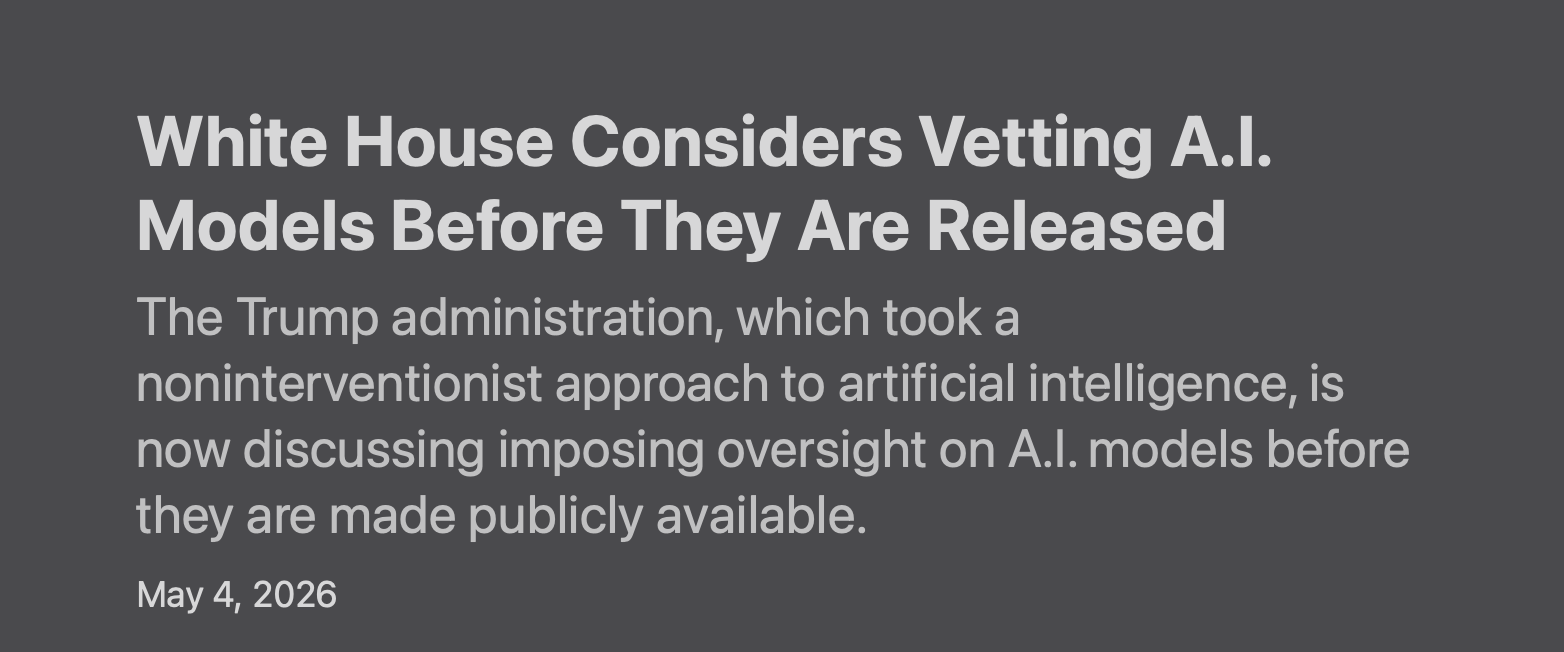
The White House’s reported move toward pre-release vetting of frontier AI models marks a significant and necessary evolution in policy. For years, the dominant narrative has centered on speed, innovation, and geopolitical competition, often at the expense of meaningful safeguards. But as models become more capable in cybersecurity, military applications, misinformation, and societal disruption, governments are increasingly acknowledging that oversight is not an obstacle to innovation; it is a prerequisite for sustainable innovation.
Anthropic’s decision not to publicly release its Mythos model due to security concerns appears to have accelerated this policy reconsideration. When even leading developers recognize that certain systems may pose substantial risks, governments have a responsibility to establish frameworks that ensure these technologies are assessed before broad deployment.
This is why the U.S. and U.K. approach deserves support.
A structured review process for advanced AI models can:
• Reduce catastrophic cybersecurity and national security risks
• Establish accountability for developers of highly capable systems
• Build public trust in AI deployment
• Create clearer standards for responsible innovation
• Prevent reactive regulation after harm has already occurred
Europe’s AI Act has already demonstrated that governments can lead on regulation without abandoning technological progress. While no framework is perfect, Europe has set a global benchmark by proactively defining risk categories, compliance obligations, and governance structures.
Now, if the U.S. and U.K. move toward similar oversight mechanisms—adapted to their own regulatory cultures, it could represent the beginning of a broader international alignment on frontier AI governance.
This is not about slowing progress. It is about recognizing that transformative technologies require governance proportional to their power.
The next phase of AI leadership will not belong solely to those who build the fastest models. It will belong to those who build the safest, most trustworthy, and most governable systems.
More governments should follow.
Responsible regulation is no longer optional. It is becoming a strategic necessity.
source